
Airtable 2026: All Grown Up with Everywhere to Go
The Case for Airtable as the Business Backbone for Modern SMBs
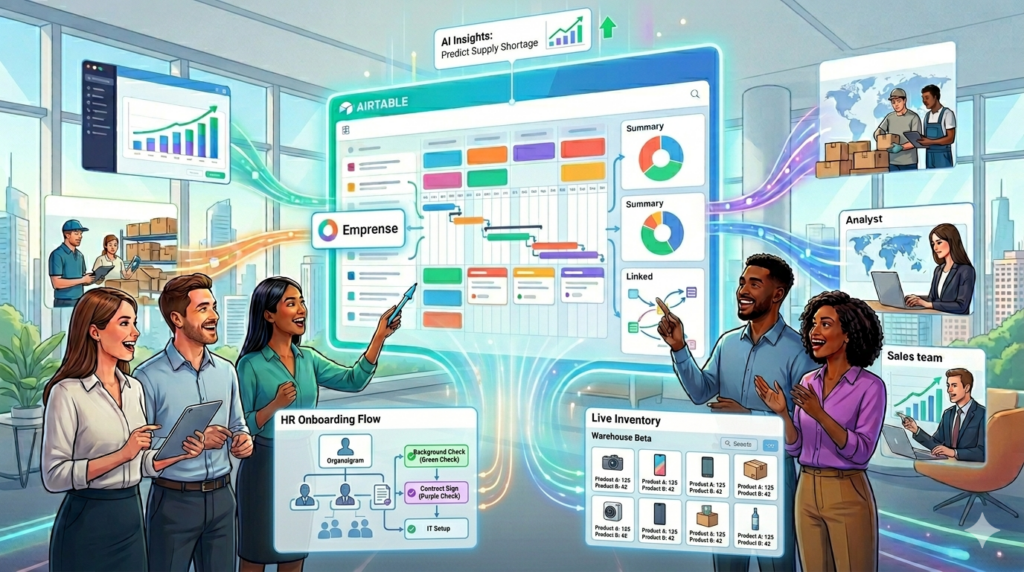
Whether you’re a solo founder juggling 12 tabs or a manager leading a 50-person team with opinions about everything, Airtable is well-suited to meet your business needs.
Airtable’s flexible work platform means:
- You get the simplicity of a spreadsheet (rows and columns)
- The power of a database (connected, structured data)
- Plus the ability to build custom interfaces, workflows, automations and dashboards – all in one place
A lot has changed since we first dove deep into the platform. Airtable is no longer just another fancy spreadsheet – it’s matured into a sophisticated relational database and AI-powered operating system, making it one of the most affordable business automation tools for SMBs.
Let’s break down what that means and how you can use our Airtable database development services to smash your 2026 business goals.
So … What Is Airtable and How Can It Help Your Business?
At its core, Airtable is a low-code platform that lets you build custom, collaborative apps that align with how your business actually runs. Airtable is a powerful hybrid platform that blends the intuitive, row-and-column familiarity of a spreadsheet with the structural backbone of a relational database.
Airtable allows teams to organize complex data—like project tasks, inventory, or CRM leads—while offering the flexibility to visualize that information through diverse lenses, including custom interfaces, as well as Kanban boards, Gantt charts, and calendars. By providing a low-code environment where builders can create custom interfaces for their workflows and automate repetitive tasks without writing lines of code, Airtable transforms static data into a dynamic “single source of truth” tailored to the specific needs of any business.
With Airtable, you can also add a little AI to:
- Get a sentiment analysis of customer reviews
- Draft emails and personalized marketing content
- Categorize and summarize data in seconds

The 2026 Core Components
- Bases: Your “apps.” A base (short for database) contains all of the information you need for a specific project, department, team or function.
- Linked Records: Unlike a spreadsheet where data is static, Airtable is a relational database which allows you to link a “customer” to an “invoice” and a “project.” Update something once (like a phone number) and it updates everywhere. No more “which version is right?” detective work.
- Interface Designer: A drag-and-drop tool that allows you to build custom interfaces or dashboards. You can create specific and custom interfaces for your team so members only see the data they need to act on and provide the functionality that they need.
- Airtable AI: AI usage as you want it, on your terms. The built-in AI can summarize records, write emails, categorize feedback and translate content directly within your workflow. It’s like adding a new assistant that everyone can access. While connected external AI systems can add powerful capabilities to any solution, AI can also be disabled entirely for all or parts of your systems.
Why Airtable Matters for SMBs Right Now – In 2026, the competitive landscape for small- and medium-sized businesses (SMBs) is defined by speed and data-driven agility, making Airtable the perfect partner.
The Airtable Advantages
Say Goodbye to “App Fatigue.” CRM. Project management. Inventory tracking. Instead of paying for separate subscriptions for each and duct-taping them together, Airtable says – what if it all lived in one place?
The results: Fewer subscriptions, fewer data silos, fewer “Can you re-send that spreadsheet?” moments.
Built to Grow (Without Breaking the Budget). Airtable’s subscription tiers (Free, Team, Business and Enterprise) allow SMBs to start small and scale. With limits now reaching up to 125,000 records per base on the Business plan, even rapidly growing companies won’t outgrow the platform.
Achieving Your Business Goals with Airtable
To hit your 2026 KPIs, you need more than just a place to store data – you need a system that works for you. Here’s how to map Airtable to your goals:
- Goal #1: Increase Operational Efficiency
Airtable solution: Automations
How it works: Set up “triggers” and “actions” to handle the busywork. When a client signs a contract (trigger), Airtable can automatically create a folder in Google Drive, send a Slack message to the team, and draft an onboarding email (action).
The Result: Less “work about work.” More actual work on high-value tasks.
- Goal #2: Improve Customer Retention
Airtable Solution: Custom CRM + AI feedback loops
How it works: Use Airtable to track every customer touchpoint, then let AI analyze support tickets or survey responses to flag “at-risk” customers before they disappear.
The Result: A proactive service model that anticipates customer needs and fixes problems before they fester.
- Goal #3: Accelerate Content & Product Launches
Airtable Solution: Timeline + Gantt Views
How it works: Switch between a Form view for data entry and a Gantt chart to visualize dependencies. If a product launch is delayed by two days, you can shift the entire timeline with one drag and every team member’s view updates instantly.
The Result: Clear accountability and faster go-to-market speeds.
If you need help implementing these features, check out our Airtable consulting services. We can help guide you in the right direction.
Ready to Put Airtable to Work?
Airtable isn’t just a tool for organizing data—it’s a tool for organizing your business. By turning your unique workflows into custom applications, you gain the “big tech” advantage on a “small business” budget.
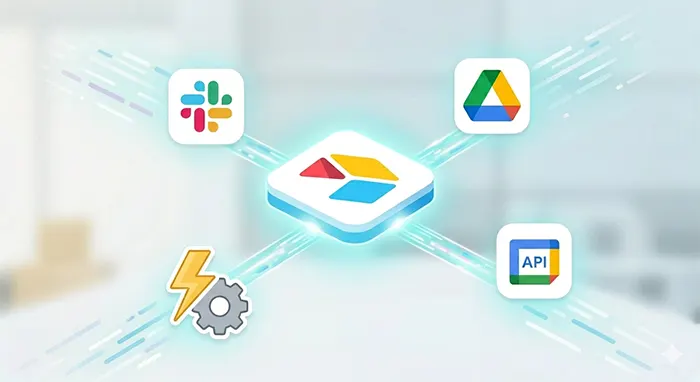 If your business is still running on spreadsheets here, data there, manual work everywhere, it’s time for an upgrade because in 2026, the winners aren’t the ones with the most tools—they’re the ones using better-connected ones.
Book your free strategy call by contacting our solution consultants.
Build smarter. Move faster. eXcelisys + Airtable.



Leave A Comment